Tip-over, anchors and the rule behind them
Tall furniture falls forward when a child climbs it or a loaded drawer swings out. There is a federal rule about that, there is hardware in the carton, and there is a five-minute job that ends the risk.
What actually happens when a cabinet goes over
A cabinet tips forward when its center of mass moves past the front feet. That is the short version. In practice, it usually happens because somebody put weight on an open drawer, or a child climbed the front to reach something on top. The higher that weight sits, the less force it takes. A tall bookcase with a half-open bottom shelf can go over with a push you would not notice if you gave it to a door.
The motion itself is faster than most people expect. Once the front edges lift off the floor, gravity does the rest. There is no slow wobble or warning creak. By the time you hear it, the piece has already picked up speed, and it will not stop until it hits something solid.
We anchor 43 of our pieces for this reason. The hardware goes into the carton at no extra charge, and we do not sell it as a separate add-on later. If you buy one of those pieces, the brackets and straps are already there. You still have to install them. That step takes roughly five minutes with a drill and a stud finder.
Anchors do not make a cabinet earthquake-proof, and they will not hold if you skip the wall stud. They also do nothing for a piece that sits on thick carpet without the right fasteners. What they do is remove the single most common cause of these accidents: the unsecured tall thing in a room where children play or sleep.
The rule, and when it arrived
The rule has a name. It is called ASTM F2057, and it took effect in 2009 for clothing storage units sold in the United States. Before that year, manufacturers set their own stability standards. Some tested carefully. Others did not test at all. The federal rule changed that by writing one test that every unit above a certain height had to pass before it could leave the factory.
We include anti-tip hardware with 43 of our pieces. That number covers nearly everything we make that stands taller than about thirty inches. A low console or a small bench does not need it because the physics of tipping does not apply to something that short. But any cabinet where a child can reach a drawer or climb onto an open shelf falls under the standard.
The rule does not care who made the furniture or what it costs. It cares about height and weight and how far a drawer pulls out. If a piece hits those thresholds, it must resist a specific pull force at the top without tipping forward on a carpeted surface. We run that test on our own assembled samples during design. When a prototype fails, we go back to the drawing board and change the proportions or add weight to the base until it holds.
Enacted in 2022, the STURDY law (15 U.S.C. § 2056f) directs CPSC to promulgate rulemaking for clothing storage units.
U.S. Consumer Product Safety Commission, Clothing Storage Units (Business Guidance). Read 22 August 2026. Source
What the rule covers, measured rather than described
The rule draws a line by height. If a piece of furniture stands 86″ or taller from the floor to its top surface, it falls under the standard. We measure that distance on the assembled unit, not on the box or the individual panel. A low console table at 30 inches stays outside this rule. A tall pantry cabinet at 72 inches sits squarely inside it. The number is what matters here, not how we or anyone else chooses to label the piece.
Width and depth do not count for this test. A narrow bookshelf that barely clears the threshold triggers the same requirement as a wide sideboard that does. The regulation looks at one dimension only: how far up the thing reaches once you have put it together. This means some of our smaller pieces in the Bookshelves department qualify while a short entryway bench does not, even if the bench weighs more.
We include anti-tip hardware with 43 of our pieces. That covers every item in our range that meets the height threshold. You will find the brackets, straps, and screws taped inside the carton, not sold separately as an add-on. If a HOSTACK piece stands tall enough to need anchoring, the parts to anchor it are already there. You should not have to buy them twice.
A “clothing storage unit” is defined as a “furniture item with drawers and/or hinged doors intended for the storage of clothing typical with bedroom furniture”
U.S. Consumer Product Safety Commission, Clothing Storage Units (Business Guidance). Read 22 August 2026. Source
What it does not cover, and why that is not a free pass
The rule does not cover every piece we make. Low consoles, most entryway benches, and the shorter microwave carts sit below the height threshold. A rolling kitchen island on casters falls outside it too, because the standard was written for stationary furniture. If you buy one of those items, you will not find anchor brackets in the box. That does not mean the piece cannot tip. It means the federal language stops at a certain point, and you take over from there.
We include anti-tip hardware with 43 of our 163 pieces anyway. The team puts it in the carton for tall dressers, hutches, and any bookcase that a small child could reach. We do this because the rule is a floor, not a ceiling. A cabinet can be technically exempt and still pull over if someone yanks an open drawer or climbs the front.
Short furniture has its own risks. A child who stands on a low bench to reach a shelf can still knock it forward onto himself. An empty trash-can cabinet is light enough to tip if a toddler hangs on the door. These pieces do not trigger the regulation, but they behave like any other object with a high center of gravity and a narrow base.
So check the piece you own or the one you are buying. If it ships with anchors, use them. If it does not, ask whether the spot where it will live needs extra stability anyway. A wall strap costs less than a minute to install, and it works on furniture the rule never mentions.
Products that are not within scope include bookcases or entertainment furniture, office furniture, dining room furniture
U.S. Consumer Product Safety Commission, Clothing Storage Units (Business Guidance). Read 22 August 2026. Source
The pull test, in pounds
The rule does not guess. It measures. The test is simple enough: a lab pulls the top of a cabinet forward with a rope, and we record how many pounds it takes before the piece tips off its back feet. That number is what decides whether an anchor kit has to go in the box.
We run this test on every tall piece before we finalize the design. If it fails at fifty pounds, we add weight to the base or change the depth until it passes. The pull test says nothing about what a shelf carries. That is a separate figure from a separate test, and the highest one we publish anywhere in the range is 800 lb.
A lower number is not a defect. It tells you something real about where the piece should live. A bookshelf that tips at thirty-five pounds belongs against a wall, not in the middle of a room where a toddler can grab it from both sides. We publish the numbers so you can match the cabinet to the household, not just to the space it fills.
43 of our 163 pieces ship with anti-tip hardware included. You do not need to buy it separately or hunt for the right bracket size. It is already in the carton, and the section on what comes in the box lists what that kit contains.
Horizontal force – Apply 10 lb of force at highest hand-hold (no higher than 56 in.) for 10 seconds
U.S. Consumer Product Safety Commission, Clothing Storage Units (Business Guidance). Read 22 August 2026. Source
The carpet test, and the child on the drawer front
The second test is harder to pass. It starts the same way: you pull the top of the unit forward with a set amount of force, usually 50 pounds for most of what we make. But this time the furniture sits on a carpeted surface, not a hard floor. Carpet lets the legs shift. The front edge digs in slightly when you pull, and that changes where the weight sits.
Then they put a 50-pound weight on the open drawer or door. This simulates a child climbing or leaning on it while it is extended. The combined force from your pull and the weight on the drawer has to stay under the tipping point. If the cabinet lifts off the floor at the back legs, it fails. A piece that passes on hardwood can fail here simply because the surface underneath is softer.
We design for this test because we know where our furniture ends up: living rooms with rugs, bedrooms with carpet, playrooms with padded flooring. The 43 pieces in our range ship with wall anchors already in the carton, not as an add-on you have to buy separately. Anchoring takes the carpet variable out of the equation entirely. Once the bracket is tight to the stud, the surface below does not matter anymore.
This matters most for pieces with large drawers that extend fully. Our dressers and low bookcases hold substantial weight by design, and that works against stability when a drawer is pulled out and loaded from the front. If you have young children in the home and carpeted floors, anchoring is not optional. It is the one step that makes the test result irrelevant to your actual setup.
Carpet with child weight – Place the test block under the rear legs and hang the 60 lb test apparatus on the front of the door or extendible element most likely to cause tip-over for 30 seconds
U.S. Consumer Product Safety Commission, Clothing Storage Units (Business Guidance). Read 22 August 2026. Source
What comes in the carton
43 of our 163 pieces ship with anti-tip hardware already in the carton. You will not find it taped to the outside or sold as a separate kit. We put the brackets, screws, and wall anchors in the box because we want them there when you open it. If they were an add-on, some people would skip them. We would rather you had them and did not need them than needed them and did not have them.
The hardware itself is straightforward. You get two L-shaped metal brackets, wood screws for the top of the cabinet frame, and the appropriate fasteners for your wall type. For plaster or drywall without a stud behind it, we include anchors that spread inside the wall when you drive the screw. The package also has a short instruction sheet with diagrams. It is not a long manual. Five minutes and a drill, or a screwdriver if you prefer, and the job is done.
We do not include a tether strap or cable system on any piece in our range. Those exist, but we use fixed brackets instead. A bracket does not stretch. It cannot work loose over time the way a strap can if someone pulls on the furniture repeatedly. This choice means you need to locate a stud or use the included anchors correctly, but it also means the connection stays rigid for as long as the furniture stands in that spot.
One thing the carton does not contain is a promise that anchoring makes a piece childproof. An anchored bookshelf will not tip forward onto a climber, but a child can still slam fingers in a drawer or pull heavy items off a low shelf. Anchoring removes one serious risk. It does not remove every risk.
Anti-tip device that meets ASTM F3096 must be packaged with the product
U.S. Consumer Product Safety Commission, Clothing Storage Units (Business Guidance). Read 22 August 2026. Source
Fixing to plasterboard, to a stud, and to neither
Most walls in an apartment are plasterboard over wood studs. The anchors we include work with both, but they work differently, and the difference matters. If you hit a stud when you drill, use the long screw and drive it straight into the wood. That is the strongest hold you will get, and it is what we design for first.
If you miss the stud and land in plasterboard only, switch to the short screw and the plastic anchor that comes with it. Tap the anchor into the hole until it sits flush, then drive the screw until the head presses against the bracket. This hold is weaker than a direct stud fix, so check it once a year by pulling on the strap with your hand. If anything moves, tighten it or relocate to a stud.
Some of you live where drilling into the wall is not allowed. We understand that. You can still reduce the risk without anchors: place the heaviest items on the bottom shelves, never open more than one drawer at a time, and keep climbing children off the furniture entirely.
These steps do not replace a wall fix, but they lower the chance that a cabinet tips forward under normal use. A piece that is low and wide needs this help less than a tall narrow one does, and that is why we list dimensions for every item in our catalog.
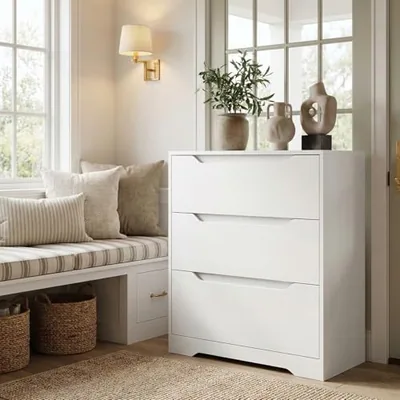
Loading a cabinet so it stays where you put it
Anchors keep a cabinet from tipping. They do not stop it from wobbling, and they do not make up for how you load the shelves and drawers once the piece is in place.
Put the heavy things low. A slow cooker on a bottom shelf pulls the cabinet toward the floor. That same weight at the top works like a lever when someone tugs an open drawer or climbs the front. If you own one of our 70 pieces that publishes a load figure, we tested it with the weight distributed this way. The highest-rated item in our range holds 800 lb, but only if you follow the same pattern we used in our test.
Drawers matter too. Fill the bottom ones before you put anything in the top. An empty upper drawer is light to pull, which means it swings out fast and carries momentum when it stops against the cabinet body. A full lower drawer stays where it is because it has mass behind it. This is not about the anchor hardware. It is about physics, and you have more control over it than you might think.
We know that some people use a bookshelf as a room divider or set a console table where it shows from both sides. That is fine for how it looks. For how it stands, though, a piece needs a wall behind it and weight near the floor.
If your room layout does not allow that, pick something shorter or wider instead of counting on the anchors alone. We make 160 pieces across nine departments, so there is usually an option that fits the space without asking the hardware to do work it was not designed for.
| Band | Height | Pieces | From |
|---|---|---|---|
| Counter height and below | 0″ to 36″ | 69 | $79.99 |
| Chest and low shelf | 36″ to 60″ | 19 | $149.99 |
| Tall, still under most ceilings | 60″ to 72″ | 48 | $169.99 |
| Wall height, anchor it | 72″ to 86″ | 24 | $119.99 |
Rooms where a child sleeps
A child's bedroom is the place where this risk shows up most often, and it is also where we think about it hardest when we draw a piece. A dresser or a nightstand in that room will almost certainly be climbed on. It might get a drawer pulled out while someone stands on the open front. We cannot change how kids behave. What we can do is make sure the furniture does not go with them.
Our bedroom range includes 14 pieces, and each one ships with 43 anti-tip hardware already inside the carton. You do not need to buy a kit separately or figure out which bracket fits. The straps and screws are packed with the panels before we seal the box. That is deliberate. If the hardware is there when you unpack, you are more likely to use it before the room gets occupied.
This matters more for some rooms than others. A console table in an entryway rarely sees a climber. A bookshelf in a home office usually does not either. But any piece you put where a child sleeps should be anchored on the day you assemble it. Not next weekend. Not after you find the right drill bit. Right then.
If you are shopping for a nursery or a kid's room now, look at our Kids Storage department. Those 4 pieces are designed for exactly this environment: low centers of gravity, wide bases, and anchor points built into the frame from the start. They still require the same five-minute installation. Every tall piece does. But they give you less weight to worry about in the first place.
Sources we read for this piece
- U.S. Consumer Product Safety Commission, Clothing Storage Units (Business Guidance). Read 22 August 2026.
- U.S. Consumer Product Safety Commission, Clothing Storage Units (Business Guidance). Read 22 August 2026.
- U.S. Consumer Product Safety Commission, Clothing Storage Units (Business Guidance). Read 22 August 2026.
- U.S. Consumer Product Safety Commission, Clothing Storage Units (Business Guidance). Read 22 August 2026.
- U.S. Consumer Product Safety Commission, Clothing Storage Units (Business Guidance). Read 22 August 2026.
- U.S. Consumer Product Safety Commission, Clothing Storage Units (Business Guidance). Read 22 August 2026.