Engineered wood, and what a shelf actually holds
Most affordable storage furniture is made of panels rather than planks. That is a real material with real numbers, not a compromise nobody will admit to, and it behaves in ways worth knowing before you load a shelf.
What a panel is, and what it is not
Most affordable storage furniture starts as a panel. We build 143 of our pieces on engineered wood panels, and that number covers nearly everything we make. A panel is not a solid plank. It is layers of wood fiber pressed together with resin under heat until they bond into a single flat sheet. The surface you see is usually a printed or veneered layer glued on top.
This construction does what a single board cannot. It stays flat across 72″ without the warping or splitting that happens to wide solid wood. It costs less because mills can use smaller trees and trimmings that would otherwise go to waste. Those are genuine advantages, and we rely on them for every price between $79.99 and $329.99.
What a panel will not do is age like hardwood. You cannot sand it down to bare wood and refinish it. The edges are vulnerable if water sits on them long enough. And while the material itself is strong in certain directions, it is heavier than solid pine or poplar of the same thickness. If you want furniture you will refinish someday, or pieces light enough to move alone up a flight of stairs every few months, engineered wood may frustrate you.
We use it anyway, and so does most of the industry at this price point, because it lets us put a functional shelf or cabinet in your home for around our median of $189.99. The tradeoffs are real. They are also predictable once you know what you are looking at.
The three kinds you will meet
Most of our 143 pieces are built on one of three panel types, and you will see the differences if you look at a cut edge or an unfinished back. Particle board takes compressed wood chips and resin and presses them into a dense sheet. It is the heaviest option for its thickness, and it holds screws less eagerly than the others do. We use it where weight matters more than repeated disassembly: fixed shelves, cabinet bases, the parts that stay put once you have assembled them.
Medium-density fiberboard, or MDF, starts with finer fibers than particle board does. The result is a smoother surface that paints and laminates cleanly, and that is why you will find it on door panels and drawer fronts across our range. MDF does not grain like solid wood, so a scratch stays visible unless you cover or fill it. It also absorbs moisture faster at an exposed edge, something to remember if a piece will live near a sink or in a basement.
Plywood bonds thin wood veneers with adhesive, usually in odd-numbered layers so the grain runs in alternating directions. It resists sagging over a span better than either particle board or MDF does, and it accepts screws more reliably when you need to re-tighten them later.
You will find plywood on our longer shelves and on any surface we rate above 800 lb. Not every piece needs it. A short pantry shelf carries its load fine on particle board, and switching it to plywood would add cost without changing what the shelf can actually hold.
The label on a product page does not always tell you which panel is inside. If it says "engineered wood," that covers all three. We list the material by type where we can, but some of our retail partners compress that information into a single category. When the specification is vague, check whether the piece publishes a load figure for its shelves: 70 of our 163 do. A stated capacity tells you more about how a shelf will perform in daily use than the panel name alone does.
These products include: hardwood plywood, medium-density fiberboard, and particleboard, as well as household and other finished goods containing these products.
U.S. Environmental Protection Agency, Formaldehyde Emission Standards for Composite Wood Products. Read 22 August 2026. Source
Formaldehyde, and the label that exists because of it
Formaldehyde shows up in the resin that holds engineered wood panels together. It is a small molecule, and it off-gasses over time, and that is why you can smell fresh particleboard in a closed room. That smell fades as the material ages and the gas dissipates, but the question of how much was there to begin with is what the labels address.
We build 143 of our pieces on engineered wood panels, so this applies directly to most of what we make. We do not test each board ourselves or publish emissions data for individual items, but we can tell you that the panels we use carry the standard industry certifications.
If you want a number on a label before you buy, look for CARB Phase 2 compliance or an EPA TSCA Title VI mark on the product specification. Those are the two standards that matter right now in the United States, and they set limits on how much formaldehyde a finished panel is allowed to release.
A shelf that sits in a well-ventilated room will behave differently from one inside a small, unventilated closet. This is not about the panel failing. It is about where you put it. If someone in your household is unusually sensitive to chemical odors, or if you are furnishing a space with almost no air exchange, solid wood avoids the question entirely. Our range includes pieces built on other materials, and those may be worth considering if off-gassing is a concern you would rather not manage.
After March 22, 2019, composite wood products must be labeled as TSCA Title VI compliant.
U.S. Environmental Protection Agency, Formaldehyde Emission Standards for Composite Wood Products. Read 22 August 2026. Source
Who checks, and what the check is worth
A stated load is a figure about the board, the span and the way the weight sits. It assumes the load lies flat and still across the full width, and it assumes the piece is assembled as the instructions describe, with the back panel on and the fixings tight. A shelf that bows under books is usually carrying them in one heap in the middle of an unsupported span rather than exceeding the number on the page.
70 of our 163 pieces list a weight limit, and the strongest shelf we make is rated for 800 lb. That figure tells you what the board can carry across its full width when the load sits flat and still. It does not account for a child climbing the side, or someone sitting on an open drawer to reach a high shelf.
It also does not cover a single heavy object resting in the middle with nothing on either end. A shelf that holds 800 lb of distributed paperbacks will sag under forty pounds of concentrated cast iron.
This matters because engineered wood does not warn you before it fails. Solid lumber creaks. Panels simply bend, and they keep bending until the joint at the back gives out. We include anti-tip hardware in 43 of our cartons because we know what a loaded bookcase does when a toddler hangs on it. The check we perform is not a federal certification. It is us filling a shelf and waiting to see if it stays straight.
The final rule also established a third-party certification program for laboratory testing and oversight of formaldehyde emissions from manufactured and/or imported composite wood products.
U.S. Environmental Protection Agency, Formaldehyde Emission Standards for Composite Wood Products. Read 22 August 2026. Source
What a shelf holds, and where the number comes from
We publish a load rating for 70 of our 163 pieces. The highest figure on any of them is 800 lb. That number is not a guess, and it is not what the shelf will hold forever without a single mark.
Here is how we arrive at it. We fill a shelf with weight in steady increments until we see the first visible bend. Then we back off and write down what it carried at that point. The number we give you is where sag begins, not where failure begins. There is a real difference between those two points, and we think you should know which one you are reading.
This also means the rating assumes the weight sits still. If you drop a stand mixer onto a pantry shelf from waist height, you are asking the panel to absorb impact force, not just static load. It may handle that once. It will not handle it every week. A shelf that holds 800 lb of canned goods can still dent if someone sets a heavy pot down hard.
If your storage plan involves anything heavier than books, dishes, or folded linens, look for the load figure before you buy. Not every shelf in our range has one published. The ones that do have been tested by us, and they are the ones we would pick for a kitchen cabinet or a garage cart. A bookshelf meant for paperbacks does not need the same backbone as a microwave cart. We do not pretend otherwise.
| Piece | Published load | Height | Department |
|---|---|---|---|
| 72″ Bookshelf with Storage, Black | 800 lb | 44.9″ | Bookshelves |
| 32″ Bookshelf with Storage, Black | 550 lb | 72.8″ | Bookshelves |
| 60″ Sideboard Buffet Cabinet, White | 450 lb | 36″ | Sideboards & Buffets |
| 32″ Kitchen Pantry Cabinet, White | 450 lb | 71″ | Pantry Cabinets |
| 60″ Sideboard Buffet Cabinet, Black | 450 lb | 36″ | Sideboards & Buffets |
| 30″ Kitchen Pantry Cabinet, White (70″ tall) | 450 lb | 70.3″ | Pantry Cabinets |
| 55″ Sideboard Buffet Cabinet, Brown | 450 lb | 39.6″ | Sideboards & Buffets |
| 30″ Kitchen Pantry Cabinet, Brown | 450 lb | 70.3″ | Pantry Cabinets |
Sag: the slow failure nobody photographs
A shelf does not usually snap. It bows. The process is slow enough that you might not notice it for months, then one day the center line of a long shelf sits an inch lower than the edges. That is sag, and once it happens the panel will not spring back.
Engineered wood resists this better than raw particleboard because the internal layers run in alternating directions, which spreads the weight across more of the material. But physics still applies. A thirty-inch shelf loaded with cookbooks behaves differently from a twelve-inch shelf holding the same books.
We publish a load figure for 70 of our 163 pieces. The highest we stand behind is 800 lb. That number comes from testing a shelf at its stated capacity over time, not from a single afternoon with weights. If a shelf sags under that load during our checks, we change the spec or we change the design.
What we cannot do is make a shelf ignore geometry. Double the span without changing the material, and the same weight produces roughly four times the deflection. This is why our wider bookcases and pantry cabinets use more support points or thicker panels.
This matters for how you actually use the furniture. A console table meant for keys and mail will carry a ceramic lamp without complaint. A low bookcase packed end to end with hardcovers may show a curve in six months if you chose the widest model and placed everything on one shelf.
We include adjustable shelves on 47 of our pieces partly so you can shorten the effective span when you need to. Move a heavy shelf up by one position, and you have cut the distance between supports roughly in half. The shelf itself has not changed. Its job just got easier.
Not every piece suits heavy storage. Our entryway benches and thinner console tables are built for coats, bags, and everyday objects rather than dense loads of books or kitchen equipment. If you need a surface that holds significant weight across a wide opening, look at our pantry cabinets or the deeper models in the bookshelf department, where we have sized the panels for that job.
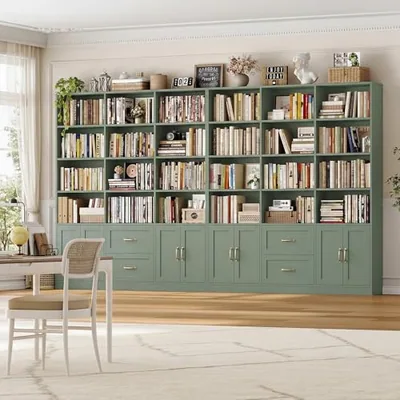
The photograph below shows one of our pieces with shelves in regular use. No visible bow. That is what the number on the page is there to promise.
Screws, cam locks and the second assembly
We use cam locks and screws to join panels, and the way they work together is not obvious until you have done it once. A cam lock is a small cylinder that sits in a predrilled hole on one panel. It catches a metal bolt that sticks out of a second panel, and when you turn it with the screwdriver we include in the box, it pulls the two faces tight.
Screws handle the rest. They go through the back panel into the sides, or through a bracket into the underside of a fixed shelf.
The second assembly happens after you own the piece for a while. Wood fibers settle under steady weight, and that pressure can make a cam lock turn a fraction looser than it was on day one. This does not mean anything broke. It means you should take your screwdriver and tighten every cam lock you can reach. Five minutes of this can stop a wobble that would otherwise get worse.
Not every shelf in our range uses the same fastener system. Adjustable shelves sit on pegs or clips, and those do not need retightening because there is nothing to tighten. Fixed shelves are the ones held by bolts and cams. They carry the weight that keeps the whole structure rigid, so they are the ones that earn a check every year or so.
One thing our furniture will not do is hold up to being taken apart and put back together more than once or twice. The holes for cam locks are sized for a snug fit, and repeated assembly wears them down until the lock cannot grip as tightly as it should. If you move, take the piece whole if you can. It will arrive stronger than it would in parts.
| What the label says | What it means for a shelf | Pieces |
|---|---|---|
| Engineered wood | Even density, no grain to split, and it holds a screw as long as the pilot hole is right | 143 |
| Adjustable shelves | You set the pitch to what you store, not to what the drawing assumed | 47 |
| Published load figure | A number to plan against instead of a guess | 70 |
| Anti-tip hardware in the carton | The strap or bracket is in the box, not an accessory | 43 |
Damp rooms, and the edge banding that matters there
143 of our pieces are built on engineered wood panels, and every one of them has a thin strip of material running along the cut edge. We call that edge banding. It is not decoration. It seals the raw particleboard or MDF core against the air. In a dry room, that seal keeps the edge from feeling rough to the touch and stops the occasional splinter. In a damp room, it does more.
Kitchens, bathrooms, laundry areas, and basements put humidity into the air steadily. Engineered wood absorbs some of that moisture through any exposed surface. When water gets into the raw edge of a panel, the fibers swell, and the board will not go back to its original shape once it dries.
You see this as a raised line along the edge of a shelf or cabinet side, and you cannot sand it flat without removing material we designed to be there. Good edge banding is the only thing standing between your furniture and that kind of damage.
We apply edge banding to all exposed cuts on our pieces, including shelf edges and the inside faces of carcase panels. The adhesive matters as much as the tape itself. If the bond fails at one spot, humidity travels under the banding along the full length of the panel, and the damage spreads out of sight until the tape lifts on its own.
This is why we do not recommend placing pieces from our range in direct contact with standing water or steam. A pantry cabinet next to a boiling kettle will test the edge banding harder than the same piece in a hallway ever will.
If you plan to put HOSTACK storage in a bathroom, laundry room, or an unconditioned basement, check that the room has consistent ventilation and that the floor stays dry. Our microwave carts, rolling islands, and trash-can cabinets hold up well near cooking and washing activity as long as they do not sit in puddles or catch direct spray.
A bookshelf or reading nook in a damp basement will last longer if you run a dehumidifier nearby. The engineered wood itself does not mind moderate humidity. It is the repeated wetting and drying that breaks the seal, and once that seal breaks, the repair options are limited.
What can be fixed and what cannot
A scratched panel is not the end of a shelf's life. You can sand it lightly and touch it up with a matching stain or paint. Most of our pieces use a finish that accepts this kind of repair without looking patched, as long as you work with the grain rather than across it. A small chip at a corner can often be hidden with a wax filler crayon in the right shade. These are cosmetic fixes, but they keep a piece in your room instead of on the curb.
What you cannot fix is water that has soaked past the edge banding into the core of a panel. Once engineered wood swells from moisture, it does not shrink back to its original shape. The surface stays raised or bubbled where the damage happened. We put edge banding on every exposed side for exactly this reason: it is the seal that keeps spills on the surface where they belong. If that seal breaks or peels away, glue it back down immediately.
A shelf that has sagged under weight will not straighten itself out just because you remove the books. The fibers have stretched past their elastic limit, and they stay stretched. Your options are to reinforce the underside with a metal strip or wood cleat, which we have done ourselves on test units, or to accept the curve and redistribute the load so it does not get worse. Prevention here costs less than repair.
We do not sell replacement panels for individual shelves. If a whole board fails, the practical path is usually to replace the entire piece rather than hunt for a matching component. This is why we publish load figures for 70 of our 163 items, with the strongest rated for 800 lb. Knowing what a shelf can hold before you fill it spares you the moment when you stare at a bent board and wonder if there is a way back.
Reading a specification without a laboratory
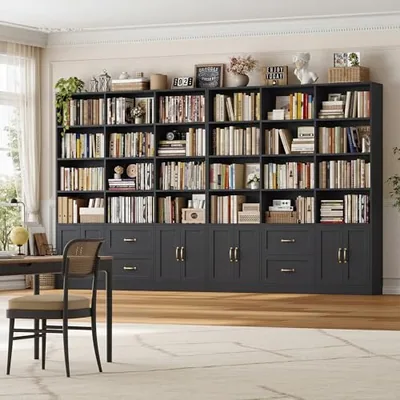
You do not need a testing lab to judge a shelf. You need the number that matters, and you need to know where we put it. Of our 163 pieces, 70 list a load rating. The highest figure we publish is 800 lb. That tells you what a shelf held when we tested it, centered and static, over a span we measured in inches. It does not tell you what the shelf will hold if you stack heavy cookbooks on one side and leave the other empty.
A width measurement helps more than you might expect. We publish dimensions on 160 of our pieces. When you know how far apart the supports sit, you can guess where the weight will go. A narrow shelf carries a load differently than a wide one, even when the material is the same. If you plan to store vinyl records or ceramic dishes, check that width before you check the finish.
We use engineered wood panels for 143 of our designs because the material is stable and it keeps the price between $79.99 and $329.99. It will not take the abuse that solid hardwood takes. It will not forgive a leak under the sink or a wet mop left on the floor. The specification cannot say whether a piece fits your kitchen or your basement. You can decide that from the numbers we print and the room you stand in.
| Piece | Price | Width | Also has LED |
|---|---|---|---|
| 55″ Kitchen Pantry Cabinet, White (HS-D7W6P) | $294.49 | 55.1″ | No |
| 45″ Kitchen Pantry Cabinet, White | $229.99 | 45.3″ | Yes |
| 55″ Kitchen Pantry Cabinet, Green (71″ tall) | $329.99 | 55.1″ | No |
| 42″ Kitchen Pantry Cabinet, White | $199.99 | 41.7″ | No |
| 42″ Kitchen Pantry Cabinet, Green | $224.19 | 41.7″ | No |
| 55″ Kitchen Pantry Cabinet, White (HS-C46T1) | $309.99 | 55″ | Yes |
| 42″ Kitchen Pantry Cabinet, Black | $199.49 | 41.7″ | No |
| 55″ Kitchen Pantry Cabinet, Green (72″ tall) | $319.99 | 55″ | Yes |
Sources we read for this piece
- U.S. Environmental Protection Agency, Formaldehyde Emission Standards for Composite Wood Products. Read 22 August 2026.
- U.S. Environmental Protection Agency, Formaldehyde Emission Standards for Composite Wood Products. Read 22 August 2026.
- U.S. Environmental Protection Agency, Formaldehyde Emission Standards for Composite Wood Products. Read 22 August 2026.